Skip to the full view

The radon story in text

Uranium occurs naturally in rock and soil. It decays into radium, and radium decays into radon, a colorless, odorless, tasteless radioactive gas. Radon moves through spaces in soil and can be drawn into buildings through pressure differences. It enters through cracks in foundations, floor-to-wall joints, gaps around pipes and utility penetrations, sump openings, construction joints, and crawl spaces. Indoors it mixes with the air people breathe in basements and living spaces. Concentrations change with weather, ventilation, and building conditions. Because radon cannot be sensed, measurement is the only way to know a building's concentration. All animation on this page is illustrative; radon is invisible.

Explore at your own paceTap to learn more about radon

Open the cross-sectionSee where radon begins and how it enters

Prefer to click rather than scroll? Choose any point in the building or the ground beneath it.Tap any marker on the house or ground to reveal that part of the radon story.

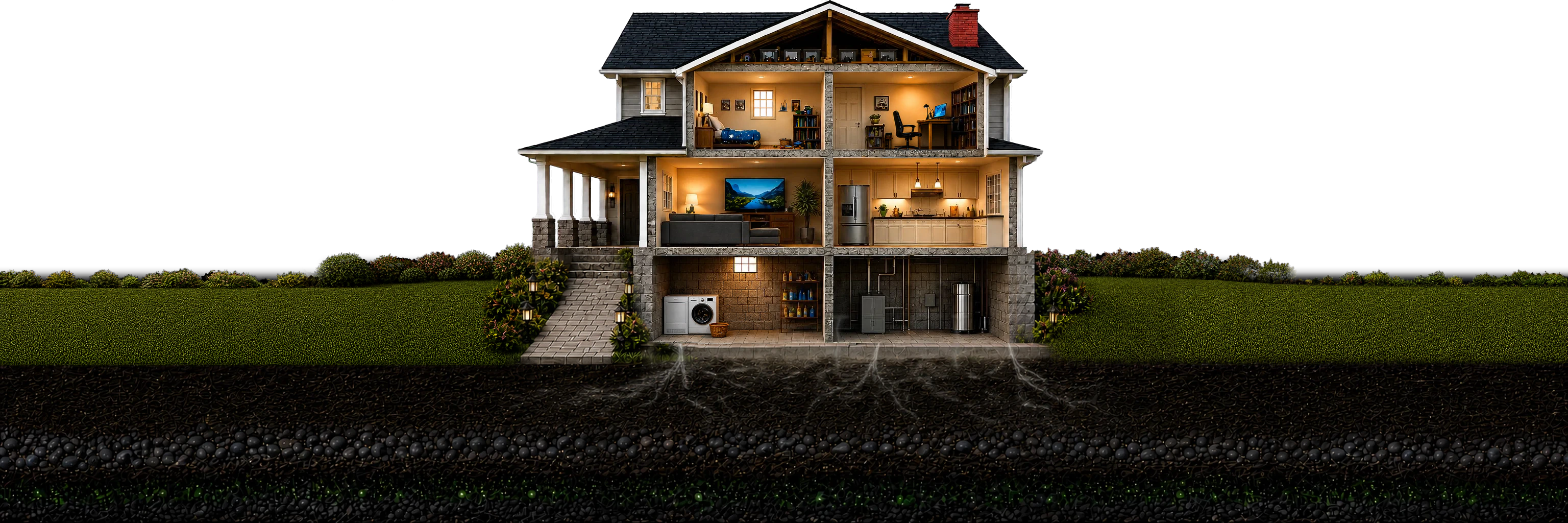
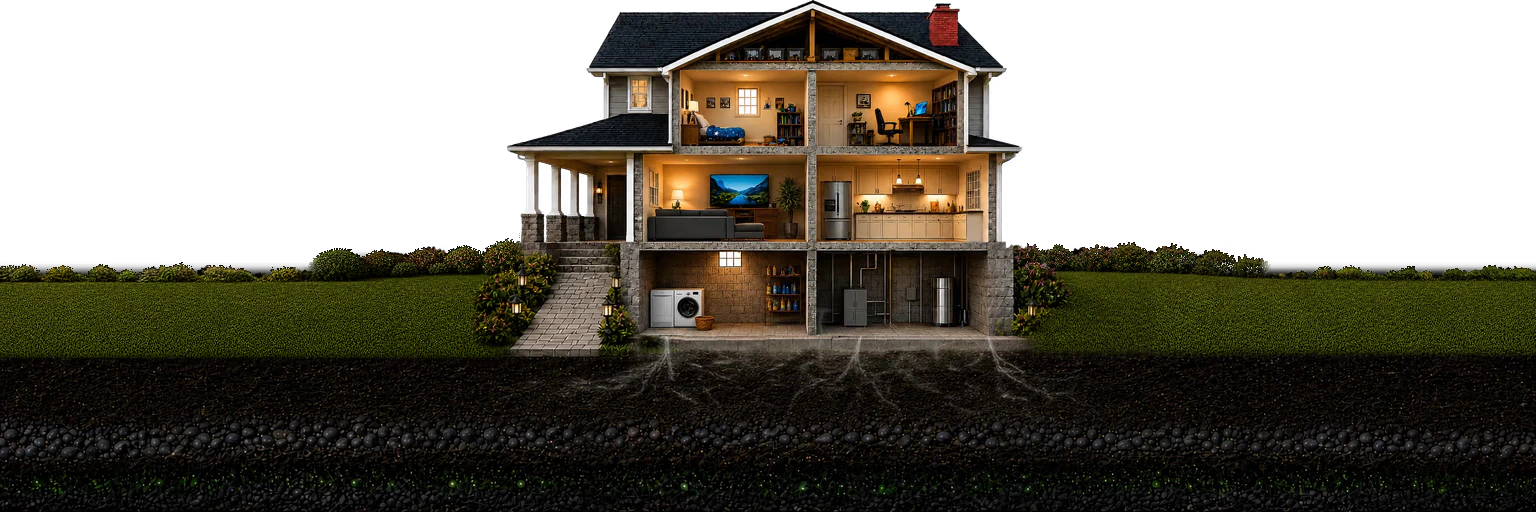
Wide cross-section of a warmly lit, unoccupied two-storey house above layers of lawn, topsoil, rock and glowing mineral deposits, with pale vapour rising from the ground toward the foundation.

Select a point

The whole picture

Radon starts in the ground, moves through soil, and can be drawn into the lowest levels of a building before mixing with indoor air. Choose a marker on the cross-section to read about that part of the path.2

Why this matters

Why radon measurement matters

Long-term exposure to elevated indoor radon increases the risk of lung cancer. Measurement is how a property owner replaces guesswork with a number.3

Health context

A known lung-cancer risk

The U.S. EPA and the World Health Organization identify radon as a leading cause of lung cancer, and EPA estimates about 21,000 radon-related lung cancer deaths each year in the United States. Risk rises with both concentration and years of exposure.

Typical concentrations

Indoor air differs from outdoor air

EPA gives the average indoor radon concentration in U.S. homes as about 1.3 pCi/L, compared with roughly 0.4 pCi/L outdoors. Individual buildings vary widely from these averages.

What changes the risk

Concentration × time

Exposure is cumulative, so the concentration and the number of hours spent in the building both matter. EPA also notes that radon exposure combined with smoking carries a greater risk than either alone.

Reading a result

What does your number mean?

Radon in air is reported in picocuries per liter (pCi/L). Move the control to see how published guidance describes a given concentration.4

2.0
WHO 2.7
EPA 4.0

Drag the marker along the scale, use the slider, or type a measured result — the explanation below updates as you go.

3.2pCi/L

2.7 – 3.9 pCi/L

Below the EPA action level and above the WHO reference level. EPA suggests considering ways to reduce radon between 2.0 and 4.0 pCi/L. A qualified professional can discuss options.

  • Below 2.0

    A lower measured concentration. EPA notes there is no known level of radon exposure that carries no risk, so continue following appropriate retesting guidance.

  • 2.0 – 3.9

    EPA recommends that property owners consider taking action to reduce radon in this range. This band also spans the WHO reference level of 100 Bq/m³, about 2.7 pCi/L.

  • 4.0 and above

    EPA recommends taking action to reduce radon at or above 4.0 pCi/L (150 Bq/m³). EPA guidance also describes confirming an initial result before mitigating.

Your number determines the next step

Where are you right now?

Choose the answer that fits. The recommendation changes with your result, so reduction information appears only when it becomes relevant.

01 · Measure

Stop guessing. Measure your home’s radon level.

A home’s age, appearance, ZIP code, and the result next door cannot tell you its radon level. A measurement can.

What we do

Professional radon testing and measurement in New Jersey

Professional radon testing for the places where people live, learn, and work.6

Residential

Homes

Radon testing and measurement for single-family houses, townhouses, condominiums, and residential transactions where applicable.

Multi-unit

Multifamily properties

Measurement planning for apartment buildings and other multifamily properties, including which units and locations to include.

Education & care

Schools and childcare

Professional measurement appropriate for occupied educational and childcare environments, coordinated around the daily schedule.

Commercial

Offices and workplaces

Radon measurement for offices and other workplace environments where staff spend regular hours.

Eight homes. One unanswered question.

1 in 8 New Jersey homes has an elevated radon level.1

From the sidewalk, all eight homes can look equally ordinary. The one with an elevated level cannot be identified by its age, appearance, ZIP code, or the result next door.

The only home you need to identify is yours.

Could you identify the home by looking?

They look the same. The measurement is what separates them.

New Jersey service area

21 counties. One clear answer.

Measurement first. Clear information. Informed decisions.

Radon Explorer provides independent radon testing, measurement, and clear reporting throughout New Jersey. We do not sell mitigation systems.

NJDEP certification MET15986

Check your municipality’s NJDEP radon potential

North Jersey

Bergen, Essex, Hudson, Morris, Passaic, Sussex, Union, and Warren

Central Jersey

Hunterdon, Mercer, Middlesex, Monmouth, and Somerset

South Jersey

Atlantic, Burlington, Camden, Cape May, Cumberland, Gloucester, Ocean, and Salem

How measurement works

Four steps, start to result

  1. Request an appointment

    You submit the property information, preferred timing, and how you would like us to reply. Nothing is confirmed until you receive a response.

  2. Confirm the measurement plan

    Radon Explorer reviews the building type and measurement requirements, then confirms the scope, timing, and appointment details with you.

  3. Measurement is performed

    The measurement is carried out according to the confirmed plan and the requirements for the property.

  4. Receive and understand the results

    You receive the measurement results with an explanation of what the reported concentration means and what published guidance says about it.

Questions

Frequently asked

What is Radon Explorer?

Radon Explorer is an NJDEP-certified company that performs radon testing and measurement for individual properties throughout New Jersey. It is a professional measurement service, not a regional radon map, database, or do-it-yourself detector.

What is radon?

Radon is a naturally occurring radioactive gas produced by the decay of uranium and radium in rock and soil. It has no color, smell, or taste, and it can accumulate indoors.

Why should a property be tested?

Because the concentration cannot be sensed or estimated from the outside. Testing is the only way to know whether indoor levels are low or elevated, and long-term exposure to elevated radon increases lung-cancer risk.

Can I tell whether a building has radon without testing?

No. Age, appearance, construction style, neighborhood, and even a neighbor’s result do not reliably predict a building’s concentration.

Do newer homes need radon measurement?

Yes. Newer construction can have elevated radon just as older construction can. Some newer buildings include radon-resistant features, but those features still need measurement to confirm the result.

Can two nearby houses have different radon levels?

Yes. Soil conditions, foundation type, openings in contact with the ground, and how a building is ventilated all differ between neighboring properties.

What does pCi/L mean?

Picocuries per liter — a measure of radioactive decay of radon per liter of air. EPA expresses its action level as 4.0 pCi/L; the WHO reference level of 100 Bq/m³ corresponds to roughly 2.7 pCi/L.

What happens during a measurement?

The measurement is set up in the agreed locations and completed according to the confirmed plan. We explain what to expect before the appointment.

How should a building be prepared?

Preparation depends on the reason for the measurement and the property. We confirm the instructions you need before the appointment.

Can occupants remain in the property?

We confirm any access or occupancy requirements for your property before the measurement begins.

How long does a measurement take?

The expected timing depends on the property and the reason for the measurement. We confirm it with the appointment details.

When should a property be retested?

Retesting guidance depends on the previous result, changes to the building, and the reason for the original test. We explain the applicable guidance along with your results.

What happens if the result is elevated?

We explain what the number means and what published guidance recommends. If you decide to pursue mitigation, you choose a qualified mitigation professional; we can point you to reduction resources, and we do not perform that work ourselves.

Does Radon Explorer install mitigation systems?

No. Radon Explorer specializes in radon measurement. It does not install mitigation systems.

Do you measure multifamily buildings?

Yes. We measure apartment buildings and other multifamily properties and will discuss which units and locations should be included.

Do you measure schools and childcare facilities?

Yes. We provide measurement for schools, kindergartens, and childcare facilities, scheduled around occupancy.

Do you measure offices?

Yes. We measure offices and other workplace environments.

Where do you provide radon testing?

Radon Explorer serves all 21 New Jersey counties. Nearby out-of-state requests, including Staten Island and Long Island, may be submitted for individual consideration. Availability is not guaranteed until we confirm applicable requirements, travel logistics, scope, and scheduling.

The one thing to do next

Know your number

Submit a professional radon measurement request for a U.S. property and choose text, email, or a phone call for our response. New Jersey is our regular service area; every out-of-state request is reviewed individually.

Prefer to email directly? Write to book@radonexplorer.com.

How would you prefer us to contact you?

Enter the U.S. property where the measurement would be performed. P.O. boxes are not accepted.

Before you submit

New Jersey requests are within our regular service area. You may enter any U.S. address, but out-of-state work is considered individually and is not confirmed until Radon Explorer reviews availability, travel logistics, applicable requirements, scope, and scheduling.

Requested, not reserved.

If known. We can advise.

If a real-estate contract applies.

For property and measurement details only. Marketing, sales, SEO, web-design, and other solicitations are not accepted.

We use these details only to contact you about this measurement request. We do not sell contact information. See the privacy policy. Appointment times are requests until Radon Explorer confirms them.

Questions before you book?

Talk to Radon Explorer.

For scheduling or questions about a measurement, use the booking request and tell us what you need help with.

Health guidance and sources

New Jersey Radon Hotline: (800) 648-0394. Guidance is periodically updated; verify recommendations against the current source.